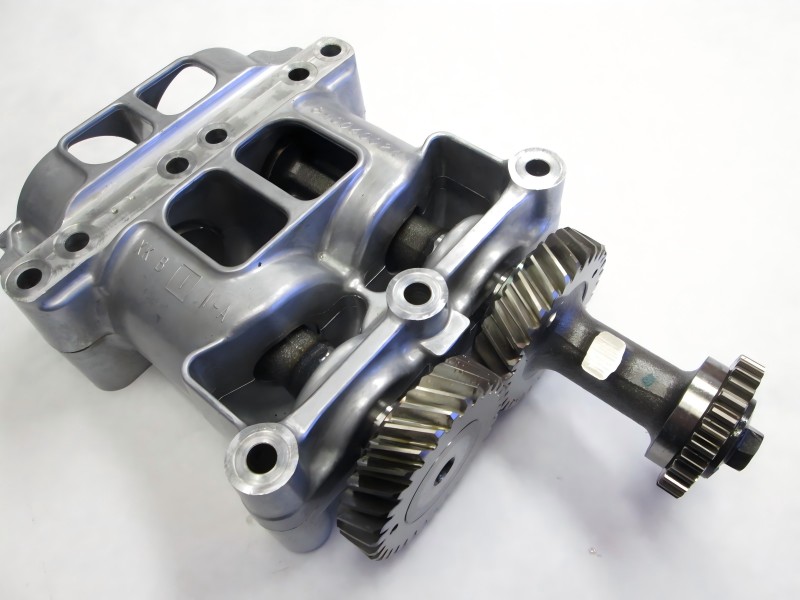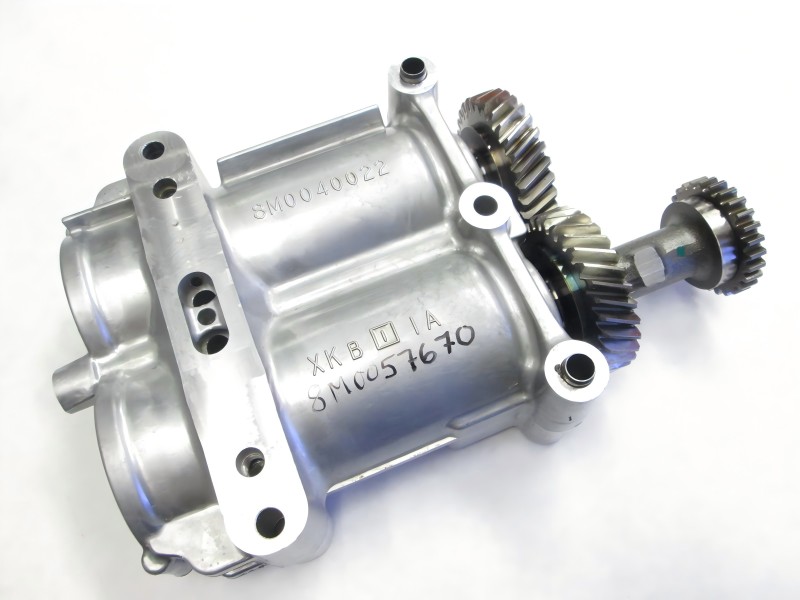













Balance shafts are most common in inline four cylinder engines which, due to the asymmetry of their design, have an inherent second order vibration (vibrating at twice the engine RPM) which cannot be eliminated no matter how well the internal components are balanced.
Flat engines have their pistons horizontally opposed, so they are naturally balanced and do not incur the extra complexity, cost or power loss associated with balance shafts.
This vibration is generated because the movement of the connecting rods in an inline engine is not symmetrical throughout the crankshaft rotation; thus during a given period of crankshaft rotation, the descending and ascending pistons are not always completely opposed in their acceleration, giving rise to a net vertical inertial force twice in each revolution whose intensity increases quadratically with RPM, no matter how closely the components are matched for weight.
The problem increases with larger engine displacement, since the only ways to achieve larger displacement are with a longer piston stroke, increasing the difference in acceleration, or by a larger bore, increasing the mass of the pistons; either way, the Magnitude of the inertial vibration increases.
For many years, two litres was viewed as the 'unofficial' displacement limit for a production inline four-cylinder engine with acceptable NVH characteristics.
The basic concept behind balance shafts has existed since 1904, when it was invented and patented by British engineer Frederick Lanchester.
Two balance shafts rotate in opposite directions at twice the engine speed.
Equally sized eccentric weights on these shafts are sized and phased so that the inertial reaction to their counter-rotation cancels out in the horizontal plane, but adds in the vertical plane, giving a net force equal to but 180 degrees out of phase with the undesired second-order vibration of the basic engine, thereby cancelling it.
The actual implementation of the concept, however, is concrete enough to be patented.
The basic problem presented by the concept is adequately supporting and lubricating a part rotating at twice engine speed at the higher RPMs where the second order vibration becomes unacceptable.
There is some debate as to how much power the twin balance shafts cost the engine. The basic figure given is usually around 15 hp (11 kW), but this may be excessive for pure friction losses. It is possible that this is a miscalculation derived from the common use of an inertial dynamometer, which calculates power from angular acceleration rather than actual measurement of steady state torque. The 15 hp (11 kW), then, includes both the actual frictional loss as well as the increase in angular inertia of the rapidly rotating shafts, which would not be a factor at steady speed. Nevertheless, some owners modify their engines by removing the balance shafts, both to reclaim some of this power and to reduce complexity and potential areas of breakage for high performance and racing use, as it is commonly (but falsely) believed that the smoothness provided by the balance shafts can be attained after their removal by careful balancing of the reciprocating components of the engine.